- The average duration of any form of radio advert is 40 seconds. However, it is permitted for them to be as short as 15 or as long as 60 seconds.
- The content of radio adverts is appropriately chosen towards to suit the needs of their audience and make them more appealing. For example, on the rock genre based radio station 'Real XS', there is no target audience, although there is a majority audience of male with an age range of 35-64 years old; many of them are from a working class background. Therefore, there are many adverts for local scrap metal dealerships, second hand cars and music shops because these are things which they are likely to be interested in.
- In radio advertisements for documentaries which are due to be shown on television, the same narrator from the documentary itself is used for the voice over. This is to help anchor meaning to the audience.
- Many documentary adverts are edited to include audio clips from the program. This helps convey the relationship between the radio advert and television documentary.
- Radio adverts are usually short, simple and always include the scheduling information, who is broadcasting the program and a strap line so listeners have a way of being able to associate the essential details with the program.
- It is common to hear a music bed in radio advertisements to make it memorable for listeners. When radio advertisements have no music bed, they can sometimes be perceived as boring and therefore do not maximise their full potential in terms of reaching a large target audience.
- The voice over and music used is often easy to understand, upbeat and clear so listeners are more likely to be persuaded into watching the program.
- The language used is aimed to suit the demographic
- They generally use the qualities of the product (in our case, the documentary) to give listeners an incentive to tune in and watch it when is being broadcasted.
Monday, January 2, 2012
Codes and Conventions of Radio Adverts

Tuesday, December 13, 2011
Codes and Conventions of Print Adverts
As mentioned previously on this blog, we chose for our program to be broadcast on Channel 4. Therefore, we felt that it would be best to note the Codes and Conventions of this media outlet's print adverts. Each program follows a set code designated by the broadcaster in a handbook. The program's creator's are allowed to design the advertisement providing it meets all of their guidelines. This code applies to any genre of program shown on Channel 4, not just for documentaries. Below are the Codes and Conventions of Channel 4's Print Adverts.

At the audience's first observation of this advertisement, they are made aware of who the central subjects are due to bright lighting being shined to the centre. They are aware of the other characters, although their vision is focused on the centre until they read the logo, the title and the scheduling information.
Image Colour
The bright colours of the character's clothing in the image sets a positive impression on the audience relating to the themes of the program. This is enhanced by the central lighting, as discussed above.
Font
Channel 4 always uses a constant font in the graphics for all of their print adverts. This is a font which was purposely created for Channel 4 to use on their own Television Advertisements (for content due to be aired on Channel 4) and for their print adverts in newspapers, magazines and print advertisements. The idea of having a constant font such as the one used above is to help engineer and promote a brand identity. The name of the font is 'C4'.
In this case, the font colour is relevant because of the program's title, 'This is England '86' relating to the colours of the English flag, which are red and white. These also blend in to the bright colours seen in the Image.
Sponsor
Not all of channel 4's print advertisements have a sponsor, although when they do, their logo appears in the top left corner of any print advertisement. This is so that the sponsor does not distort too much of the message promoting the program relating to scheduling, the image, and the Channel 4 logo.
Logo
The logo will always appear on the central right corner. Again, this is to help promote the brand identity and the program being advertised. In the case of this advertisement, some of the logo is transparent, although in many other advertisements for other programs, this area is black. There will always be white areas in channel 4's logo. The logo never:
There will never be more than three levels of a typographic hierarchy. The first line will contain a strap line (not always included), the second the title, and on the third line, the scheduling information including the date and time. In the case of the print advert above, there are only two lines. This is the title of the program, strap line and the scheduling information. The later two of the three have been mixed into the second line at the bottom.
Typographic Flexibility
Channel 4 allow some for some flexibility relating to the location of the typography. Although many of them appear on the bottom left hand side, it is allowed to appear in the top left and also central left. This is providing that the logo and image advertised is not being covered up by the typography.
These are some other examples of print advertisement which were made for Channel 4:


Lighting
Image Colour
The bright colours of the character's clothing in the image sets a positive impression on the audience relating to the themes of the program. This is enhanced by the central lighting, as discussed above.
Font
Channel 4 always uses a constant font in the graphics for all of their print adverts. This is a font which was purposely created for Channel 4 to use on their own Television Advertisements (for content due to be aired on Channel 4) and for their print adverts in newspapers, magazines and print advertisements. The idea of having a constant font such as the one used above is to help engineer and promote a brand identity. The name of the font is 'C4'.
In this case, the font colour is relevant because of the program's title, 'This is England '86' relating to the colours of the English flag, which are red and white. These also blend in to the bright colours seen in the Image.
Sponsor
Not all of channel 4's print advertisements have a sponsor, although when they do, their logo appears in the top left corner of any print advertisement. This is so that the sponsor does not distort too much of the message promoting the program relating to scheduling, the image, and the Channel 4 logo.
Logo
The logo will always appear on the central right corner. Again, this is to help promote the brand identity and the program being advertised. In the case of this advertisement, some of the logo is transparent, although in many other advertisements for other programs, this area is black. There will always be white areas in channel 4's logo. The logo never:
- is distorted
- is placed inside a box or frame
- contains text inside the '4'
- has tone added to areas where the white is supposed to be
- has an outline sounding the '4' logo
There will never be more than three levels of a typographic hierarchy. The first line will contain a strap line (not always included), the second the title, and on the third line, the scheduling information including the date and time. In the case of the print advert above, there are only two lines. This is the title of the program, strap line and the scheduling information. The later two of the three have been mixed into the second line at the bottom.
Typographic Flexibility
Channel 4 allow some for some flexibility relating to the location of the typography. Although many of them appear on the bottom left hand side, it is allowed to appear in the top left and also central left. This is providing that the logo and image advertised is not being covered up by the typography.
These are some other examples of print advertisement which were made for Channel 4:


Saturday, November 19, 2011
Copyright Issues
Emails that were sent to recieve Copyright permission:
To Whom It May Concern,
I am writing to you to request copyright permission for our student documentary which we would like to include short segment of Eat It - "Weird Al" Yankovic, this video will only be shown to the exam board and will not gain any financial profit. Thank you.
A2 Media Students at Priestley College; Sophie Riley, Daniel Orr, Robert Young and Samuel Taylor
To Whom It May Concern,
I am writing to you to request copyright permission for our student documentary which we would like to include short segment of a Just Eat advertisment, this video will only be shown to the exam board and will not gain any financial profit. Thank you.
A2 Media Students at Priestley College; Sophie Riley, Daniel Orr, Robert Young and Samuel Taylor
To Whom It May Concern,
I am writing to you to request copyright permission for our student documentary which we would like to include short segment of a Burger King advertisment, this video will only be shown to the exam board and will not gain any financial profit. Thank you.
A2 Media Students at Priestley College; Sophie Riley, Daniel Orr, Robert Young and Samuel Taylor

To Whom It May Concern,
I am writing to you to request copyright permission for our student documentary which we would like to include short segment of Eat It - "Weird Al" Yankovic, this video will only be shown to the exam board and will not gain any financial profit. Thank you.
A2 Media Students at Priestley College; Sophie Riley, Daniel Orr, Robert Young and Samuel Taylor
To Whom It May Concern,
I am writing to you to request copyright permission for our student documentary which we would like to include short segment of a Just Eat advertisment, this video will only be shown to the exam board and will not gain any financial profit. Thank you.
A2 Media Students at Priestley College; Sophie Riley, Daniel Orr, Robert Young and Samuel Taylor
To Whom It May Concern,
I am writing to you to request copyright permission for our student documentary which we would like to include short segment of a Burger King advertisment, this video will only be shown to the exam board and will not gain any financial profit. Thank you.
A2 Media Students at Priestley College; Sophie Riley, Daniel Orr, Robert Young and Samuel Taylor
Monday, November 7, 2011
Filming Diary
Sunday 23rd October 2011
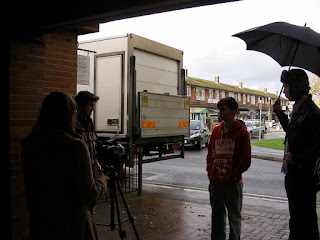
My group filmed an interview with a mother who we plan to use as a reprentative of home cooking. We asked her the following three questions:
I was not able to attend this interview, but I feel as though the correct questions were asked and that there were no problems with the footage on this occasion. From watching the footage that was filmed, I observed her comments on how teenagers sometimes prefer to be social with their friends and decide get a takeaway. This is as opposed to being with their family. Personally, I do not believe that the lighting was in this shot and the mise-en-scene was not relevent.

Tuesday 1st November 2011
On this night, we filmed an interview with the owner of The Raj indian takeaway restaurant, Anhar. We made sure that we followed the codes and conventions of documentries; more specifically documentary interviews. My group constantly thought about our mise-en-scene to try and establish that it was correct in this sense. The interview was filmed outside The Raj Takeaways's kitchen. It was clear to the audience that it was near a takeaway kitchen because of the glass windows on the doors in the background which looked inside. He answered all of the questions we asked him.
Tuesday 8th November 2011
We re-shot some of our cutaway shots from Chilli Grill, a restaurant near the centre of Warrington Town. These were mostly various types of close up shots of the food and beverage that we bought for filming.
Thursday 10th November 2011
We began editing our documentary despite not filming vox pops yet. We cut the questions being asked off from the interviews with the two parents and the owner of the Raj Indian restaurant. The aim of this was to simply create a rough cut of what we had got so far.
Monday 21st November 2011
We filmed five vox pops interviews. We did say that we would like to film three more vox pops interviews with females, as we interviewed four males and only one female. Unfortunately, we lost some of the footage during the capture process. The sound quality on these clips was also very quiet and if we tried to make it more audible then the amount of white noise would dramatically increase. Therefore, we thought it was best for these these vocks pops to be filmed once more.
Tuesday 22nd November 2011
We found five more people to interview as vox pops. This time, there was no problem with the capturing process or in the audio, so these were included in our documentary. Like yesterday, these interviews were filmed using a blue screen.
We arranged to meet up in Culcheth to film an interview with a takeaway worker and some shots of the takeaways around the area. We planned to film outside The Raj and the Village Pizza. A lot of the filming we did was done in the afternoon. This was because we hoped for the natural lighting onto the outside of the takeaways would be much better in the daytime than it is in the afternoon. This also meant that we wouldn't have to wait long before we could order a takeaway delievery in the evening. However, the weather on this day was not brilliant. It rained for some of the time. This limited the amount of filming we could do. Also, we did not have a cover for our camera when it rained, so whenever our filming was interupted by the weather, we were forced to quickly put our camera away again to avoid damage to our camera. We eventually brought an umbrella and held it above the camera so that there was some filming that we could do.
We interviewed Andy Harrison, a part time takeaway worker who also fitted into our mostly teenage target audience. This meant that he has an understanding of young people's attitudes towards takeaways. We filmed him at the side of the Village Pizza takeaway. There was a roof at the side which protected our camera from getting damaged. We focused our camera at a medium close up with the camera facing upwards to demonstrate power. However, this shot is something we will not use because we decided that the mise-en-scene was too irrelevent. We felt that the lighting was too dark and that because the background of the shot was a road with cars driving past, it had no relation to our exposition. Andy was also wearing a dark red hoody because he was off duty. This too, was not relevent to our exposition.

We filmed some panning shots of takeaway signs and still close ups of takeaway menus. The menus in particular were used as a bridge for the next part of our filming: Shots of people eating chinese takeaways at a house. We wanted a variety of close up shots on different types of chinese food. Often, we used a downward tilt on the camera with an extreme close up shot. The extreme close up demonstrates the importance of the food in relation to the exposition.

Wednesday 26th October 2011
We went back to Culcheth the following Wednesday to re-film some of our shots from more than one angle. This gives us a better choice during the editing process of the shots we could use for the finished piece. Although we already had an interview arranged with the owner of The Raj takeaway, we tried to ask some of the other nearby restaurant owners if they would like to be interviewed. We asked in Village Pizza, although they were forced to decline because the owner was not present at the time. We also asked at the Indian restaurant next door to Village pizza. In this case, the owner was present, although he declined after reading our question sheet
Sunday 30th October 2011

Wednesday 26th October 2011
We went back to Culcheth the following Wednesday to re-film some of our shots from more than one angle. This gives us a better choice during the editing process of the shots we could use for the finished piece. Although we already had an interview arranged with the owner of The Raj takeaway, we tried to ask some of the other nearby restaurant owners if they would like to be interviewed. We asked in Village Pizza, although they were forced to decline because the owner was not present at the time. We also asked at the Indian restaurant next door to Village pizza. In this case, the owner was present, although he declined after reading our question sheet
Sunday 30th October 2011
My group filmed an interview with a mother who we plan to use as a reprentative of home cooking. We asked her the following three questions:
- Do you think young people consider about their diet when they order a takeaway?
- Do you think young people order a takeaway when they're alone, with friends or in need of a quick meal?
- Why do you think teenagers choose takeaways over home cooking?

Tuesday 1st November 2011
On this night, we filmed an interview with the owner of The Raj indian takeaway restaurant, Anhar. We made sure that we followed the codes and conventions of documentries; more specifically documentary interviews. My group constantly thought about our mise-en-scene to try and establish that it was correct in this sense. The interview was filmed outside The Raj Takeaways's kitchen. It was clear to the audience that it was near a takeaway kitchen because of the glass windows on the doors in the background which looked inside. He answered all of the questions we asked him.
Tuesday 8th November 2011
We re-shot some of our cutaway shots from Chilli Grill, a restaurant near the centre of Warrington Town. These were mostly various types of close up shots of the food and beverage that we bought for filming.
Thursday 10th November 2011
We began editing our documentary despite not filming vox pops yet. We cut the questions being asked off from the interviews with the two parents and the owner of the Raj Indian restaurant. The aim of this was to simply create a rough cut of what we had got so far.
Monday 21st November 2011
We filmed five vox pops interviews. We did say that we would like to film three more vox pops interviews with females, as we interviewed four males and only one female. Unfortunately, we lost some of the footage during the capture process. The sound quality on these clips was also very quiet and if we tried to make it more audible then the amount of white noise would dramatically increase. Therefore, we thought it was best for these these vocks pops to be filmed once more.
Tuesday 22nd November 2011
We found five more people to interview as vox pops. This time, there was no problem with the capturing process or in the audio, so these were included in our documentary. Like yesterday, these interviews were filmed using a blue screen.
Friday, October 21, 2011
Inital Plan
After a thoughtful analysis as to what our documentary topic could be, we decided that our documentary would be on the topic of takeaways. We chose this topic becuase we felt it is something that every member of the audience can relate to. We felt that it would be easier to collect data related to this topic because of the large number of takeaway shops in the the local area. Therefore, it is easier to find people who are 'experts' on this topic.

We learnt about the scheduling in documentaries on many TV channels. This is so it gives us a good idea as to we when could schedule our documentary. The types of scheduling can be found below:
Inheritance - This is when the channel controllers air a documentary on after a popular show such as Coronation Street - in doing so, people may feel the need to leave their television on so that the documentary can 'inherit' the audience of the more popular show.
Pre Echo - Works in the opposite way to inheritance; a documentary could be put on before a popular show such as Coronation Street. The audience waiting to watch Coronation Street may turn the channel on early so to not miss the start of Coronation Street, and in doing so may end up watching part of or the entire documentary.
Hammocking - A sort of combination of inheritance and pre echo, where a documentary can be sandwiched in between two popular programmes on a channel and may gain extra viewers via both or either of inheritance and pre echo, and also viewers who leave the channel on after the first show as they wish to watch the second popular programme.
We also were familiarised with the types of documentary featured on different British television channels.
BBC 1 - These documentaries tend to be aimed at families.
BBC 2 - These are often the most educational documentaries out of the five main channels. However, these a sometimes more explicit and less suitable for children than the documentaries shown on BBC1.
ITV1 - The friendliest of the five channels. They are less serious documentaries than the ones aired on BBC1 and try to appeal to all audiences. ITV has shown serious documentaries in the past, including the controversial 2007 film 'Malcolm and Barbara Lover's Farewell' by Paul Watson. This documentary caused a scandal regarding the false death of Alzheimer's patient Malcolm Pointon, who actually died three days after his "death scene". Despite this, the film did raise awareness for Alzheimer's which some would argue was original goal of the documentary. This documentary was shown after 9pm to avoid upsetting any children.
Channel 4 - Many of Channel 4's documentaries are aimed at students and younger people. Often, they will have some comedy elements to them, such as in 'My Big Fat Gypsy Wedding'.
Channel 5 - These documentaries are aimed at families, although Channel 5 as a whole is thought to not differentiate it's programs enough from BBC1 and therefore does not gain as much of a large audience.
After some discussion, we came to the decision that our documentary would be called 'Tastes Like Teen Spirit' and that we wanted our target audience to be mostly students and drawing some attention from adults. The title of our documentary is a take on the world-famous Nirvana song 'Smells Like Teen Spirit'. We felt that this would be a good title as it will appeal to our target audience who will most likely be aware of the song and how the title is a play on words. We decided that it would be best for our documentary to be shown on Channel 4 on a Thursday at 8pm. This would Hammock our documentary in between the seven o'clock Channel 4 news (who are likely to have slightly more mature viewers) and Educating Essex, a documentary that is likely to be aired after ours. We decided that 8pm would be a good time to broadcast our documentary as this is a time when we believe that a large number of young people would be watching television. Many students are busy with education or work during the day time. We felt that Thursday would be a the best day because at the weekend, a lot of our target audience enjoy socialising in the evenings by visiting clubs or bars.
|
Initial Documentary Content
Once I had been put into my group, we had a large discussion to brainstorm possible ideas for a reasonable topic for our documentary. We created a long list of ideas - some of these ideas were linked together if we could think of some sub-ideas. The initial list of ideas can be seen here:
- Concerts (or music festivals)
- Sport (different types of sport, fair play in sport, prejudice in sport, etc.)
- The elderly
- Teenagers
- Prejudice (racism, hair colour, sexism, etc.)
- Social networking (dangers)
- Holidays
- Accents (regional, international, etc.)
- Holidays
- Public transport (trains, buses, local, etc.)
- Shoes
- Fashion (different generations of fashion)
- Music (different eras of music, different types of music)
- Tea and coffee
- Television and film (different eras and types of television)
- Games (different genres and eras, the evolution of games)
- Allergies
- Fruit and vegetables
- Technology (iPods, phones, computers)
- Recycling (land refill sites)
- Drugs (legal and illegal)
- Sleep (dreams)
- Clubbing (underage)
- Birthdays
- Parties (occasions celebration)
- Body-building (gyms)
- Takeaways (fast/junk food)
- Christmas (beliefs)
- Sandwiches (lunches)
- Money (finance)
- Drinking (alcohol)
- 3D (television and other technology)
- Obesity/anorexia
- Cinemas (film)
- Pets (animals)
- Pies (bakeries)
- Phobias
- Obsessions (stalking, paedophilia)
- Stereotypes
- Tattoos and piercings
- Plants (trees)
- Food (different types of food, cultural food)
- Shopping (for various different things, for example clothes or food)
- Seasons (what changes in separate seasons)
- College life
- Litter (and recycling)
- Comic books (old and new - history)
- The human body (different aspects of the body, differences between people and genders)
- Laughter (emotions)
- Feet (certain parts of the body)
- Water (liquid, hydration)
- The high street (differences between countries, regions, etc.)
- Relationships (differences in cultures, mutual relationships)
- Gambling (betting)
- Ghosts (beliefs, otherworldly beings)
- Paper
- Make up
- China
- Time
- Mediums (religion)
- Idols (role models)
- Halloween (annual events)
- Fireworks (dangers)
- Religion
Single frame storyboards

In our first frame, we are interviewing a local takeaway worker, Andy Harrison from The Village Pizza.

The second frame shows mother Janet Orr, who, in her interview, explains why she prefers home cooking to buying a takeaway.
Subscribe to:
Posts (Atom)