Friday, January 6, 2012


Evaluation
Question 1
When I noted John Corner's codes and conventions of documentaries earlier on in this blog, I talked about the themes
Observation
"This is when the camera becomes the eyewitness to some of the events taking place". People inside of the shots are meant to be oblivious to the fact that there is a camera there. We applied this convention when we filmed a panning long shot of someone walking past the Thai Paragon.

This is similar to the documentary which I chose to analyse, 'Heavy Metal In Baghdad', where US Soldiers were oblivious to the fact that they were being filmed.

Interviews
"Documentaries rely heavily on interviews. Sometimes pictures and archive footage are dubbed over the interview to make sense of what is going on". We filmed plenty of cutaway shots and dubbed them over our interviews. Often these shots were shots either of food, menus or archive footage.

This is the very first cutaway shot the audience sees in our documentary. This shot also makes an observation because of the three oblivious people on the left.

In 'Detroit Lives', this is the first cutaway shot which the audience see. This is archive footage of Detroit Chrysler workers manufacturing cars. This cutaway shot gets dubbed over the voice of Toby Barlow.
Dramatisation
John Corner talked about the idea of Dramatisation and how the audience is sometimes eyewitness to the events unfolding on screen, perhaps in the form of an industry expert who is somehow related to the exposition. This is one of the main reasons why we chose to include Restaurant owner Anhar Miah in our documentary.

In 'The Devil Made Me Do It', they also used industry professionals like we have to explain their opinion which has a relation to the exposition. Like the screenshot above, it also uses subtitles to tell the audience their name and profession. Note the similarity in the framing of these two interviews.

Mise En Scene

"Mise En Scene is used in a way to advance the argument". This is why it was very important for us to film Janet Orr inside a kitchen because of her being a mother and that she has her own experiences of cooking meals for teenagers. In documentaries, the most important things film makers need to think about with regards to mise en scene is the location and the lighting. Clothing can sometimes be an issue because what they are wearing might not actually be related to the exposition. However, it is rare for there to be an issue in documentaries with clothing in documentaries as many people just wear what they would have on normally. Therefore, documentary makers do not have to worry much about how clothing can advance an argument.

When I watched 'Detroit Lives', the audience were presented with Entrepreneur Phil Cooley who was stood inside a warehouse. The documentary was trying to show the audience how Detroit is improving from all of the poverty, crime and drug use. I think that in our documentary, we thought about the lighting much more when we filmed Janet Orr. A lot of the time, 'Detroit Lives' relies on natural light for the interviews whereas we do not. This is a flaw where I feel we did better than the other documentary.
Question 2
Question 3
I wanted to get some audience feedback from my target audience and I decided that the best place to obtain feeback from them would be on facebook, since the vast majority of my friends fit inside the target audience. The image below is proof that I have done this. You can also read what I asked them to do.

This is some of the feedback which I obtained from my peers:

I recieved a 'like' from Katherine Moreira on my documentary. The very first comment which I recieved on Facebook was from Danielle Nunnerley, who was impressed by what she watched. The problem with recieving a like and the comment which Danielle Nunnerley gave me is that this audience feedback is quite vague. She does not describe which parts of my documentary she thought were "Very insightful, and really engaging". Therefore, I believed that so far I had done everything correct until I recieved more audience feedback.

Paul Pope has talked about a good use of cutaways. This pleases me because in my editing Diary, I mentioned that we did not have enough cutaways and that I had to get some footage from YouTube. I interpret this as evidence to show that we did have cutaways in all of the correct places.

Tim Mainwaring gave me my first comment of feedback that had a criticism as well as some positive feedback. I wanted negative feedback so I know where I need to improve next time. He spoke of the information being good but the voice asking the questions is too quiet. We cut out the voice asking the interview questions as hearing it in a documentary is unprofessional. Tim is talking about our narrator's voice being too quiet. It is likely he had to turn the volume up on his speakers in order to give me the feedback he gave me. If the voice asking the questions is too quiet, this means that the "Good info" I had was being disrupted slightly. If he had to turn his volume up, then this may have made the sound from our archive footage and interviews too loud. Thanks to this feedback, I now realise that during the editing process, I needed to turn the volume up when the narrator is speaking. I should have noticed this before otherwise the feedback could have been completely positive. I wore headphones in all of my lessons where I edited and I remember trying to establish a sufficient volume throughout. I thought I had done this correctly, but apparently I had not.

Richard Alan Clarke said that my documentary "looks just like something you would see on bbc4". Although he may have meant this as positive feedback, our documentary was created to be shown on Channel 4 because it attracts younger audiences and BBC4 often attracts the opposite. This is definitely something which I did not want to hear in my feedback. His comment could have been influenced by the Narrator, who did not speak as powerful as I thought he may have when we were recording. I should have realised this and found a different narrator, although this would have caused a delay to our editing process if we re-recorded.
When Richard says "looks like it was made in the 90's though", this is definitely some negative criticism that as a creator, I relish hearing. I now know that some of the techniques I used in my documentary could have been out of date and that their were better ways to edit my documentary than I have included. For example, he may not have liked how I have used the fonts in my documentary and feels that the transitions were very basic. If this is the case, then along with my group, I should have found a transition that would flow better with the takeaway theme of the documentary. This is what I would do to improve if I had another chance.
I decided to record another member of my target audience reviewing my radio advertisement, Print advertisement and my final documentary. This was an attempt to try and obtain a much more visual answer in comparison to Facebook. The answers I received were of a much better standard detail and there was a lot more detail.
Radio Advertisement
The way we edited our radio advertisement is definitely a problem after I received this feedback. "The sound bytes don't really tell you what the program is about". If she thinks that this is the case, then my sound bytes were definitely not relevant enough. When the Narrator asks "What impact does this have on teenagers?" I think that I should have chosen a better sound byte to use than when you hear the restaurant owner speak. I believe that this is also what lead her to to opinion of the narrator needing to tell the audience more about it. Since I am the person who wrote the script for the radio advertisement, it was therefore my duty to fit more information into my radio advertisement, despite it only being 30 seconds long.
Print Advertisement
I am pleased that she said the print advertisement does "catch your eye" and entice the audience into wondering what to advertisement is about. She says the words "for the average person" which means that she was including anyone in or outside of my target audience. This may not sound like a bad thing, but I am judging it in this way because the print advertisement is supposed to attract mostly young people. In hindsight, I would say that our print advertisement does need some more colour because the only colours which we did use were shades of oranges, reds or browns on the strap line, scheduling information, name of the program and on the sauce of the meal.
Documentary Review
This is not the first time I have heard about my documentary having sound problems despite the information it gave. Like Tim Mainwaring, she does mention that the voice about the voice asking the questions is too quiet. This was in comparison to the restaurant owner's sound being too loud. I should have tried to balanced the levels of sound to a volume between these levels as I would rather not give other audience members a "shock" like she said. I am pleased that she did tell me this because it shows that video feedback can be much more informative than taking answers from Facebook. In some ways, it has helped me gain a broader understanding of what Tim Mainwaring was talking about.
For more information, please view the 'Audience Feedback' section of my blog.
Question 4
When I noted John Corner's codes and conventions of documentaries earlier on in this blog, I talked about the themes
Observation
"This is when the camera becomes the eyewitness to some of the events taking place". People inside of the shots are meant to be oblivious to the fact that there is a camera there. We applied this convention when we filmed a panning long shot of someone walking past the Thai Paragon.

This is similar to the documentary which I chose to analyse, 'Heavy Metal In Baghdad', where US Soldiers were oblivious to the fact that they were being filmed.

Interviews
"Documentaries rely heavily on interviews. Sometimes pictures and archive footage are dubbed over the interview to make sense of what is going on". We filmed plenty of cutaway shots and dubbed them over our interviews. Often these shots were shots either of food, menus or archive footage.

This is the very first cutaway shot the audience sees in our documentary. This shot also makes an observation because of the three oblivious people on the left.

In 'Detroit Lives', this is the first cutaway shot which the audience see. This is archive footage of Detroit Chrysler workers manufacturing cars. This cutaway shot gets dubbed over the voice of Toby Barlow.
Dramatisation
John Corner talked about the idea of Dramatisation and how the audience is sometimes eyewitness to the events unfolding on screen, perhaps in the form of an industry expert who is somehow related to the exposition. This is one of the main reasons why we chose to include Restaurant owner Anhar Miah in our documentary.

In 'The Devil Made Me Do It', they also used industry professionals like we have to explain their opinion which has a relation to the exposition. Like the screenshot above, it also uses subtitles to tell the audience their name and profession. Note the similarity in the framing of these two interviews.

Mise En Scene

"Mise En Scene is used in a way to advance the argument". This is why it was very important for us to film Janet Orr inside a kitchen because of her being a mother and that she has her own experiences of cooking meals for teenagers. In documentaries, the most important things film makers need to think about with regards to mise en scene is the location and the lighting. Clothing can sometimes be an issue because what they are wearing might not actually be related to the exposition. However, it is rare for there to be an issue in documentaries with clothing in documentaries as many people just wear what they would have on normally. Therefore, documentary makers do not have to worry much about how clothing can advance an argument.

When I watched 'Detroit Lives', the audience were presented with Entrepreneur Phil Cooley who was stood inside a warehouse. The documentary was trying to show the audience how Detroit is improving from all of the poverty, crime and drug use. I think that in our documentary, we thought about the lighting much more when we filmed Janet Orr. A lot of the time, 'Detroit Lives' relies on natural light for the interviews whereas we do not. This is a flaw where I feel we did better than the other documentary.
Question 2
Question 3
I wanted to get some audience feedback from my target audience and I decided that the best place to obtain feeback from them would be on facebook, since the vast majority of my friends fit inside the target audience. The image below is proof that I have done this. You can also read what I asked them to do.

This is some of the feedback which I obtained from my peers:

I recieved a 'like' from Katherine Moreira on my documentary. The very first comment which I recieved on Facebook was from Danielle Nunnerley, who was impressed by what she watched. The problem with recieving a like and the comment which Danielle Nunnerley gave me is that this audience feedback is quite vague. She does not describe which parts of my documentary she thought were "Very insightful, and really engaging". Therefore, I believed that so far I had done everything correct until I recieved more audience feedback.

Paul Pope has talked about a good use of cutaways. This pleases me because in my editing Diary, I mentioned that we did not have enough cutaways and that I had to get some footage from YouTube. I interpret this as evidence to show that we did have cutaways in all of the correct places.
Tim Mainwaring gave me my first comment of feedback that had a criticism as well as some positive feedback. I wanted negative feedback so I know where I need to improve next time. He spoke of the information being good but the voice asking the questions is too quiet. We cut out the voice asking the interview questions as hearing it in a documentary is unprofessional. Tim is talking about our narrator's voice being too quiet. It is likely he had to turn the volume up on his speakers in order to give me the feedback he gave me. If the voice asking the questions is too quiet, this means that the "Good info" I had was being disrupted slightly. If he had to turn his volume up, then this may have made the sound from our archive footage and interviews too loud. Thanks to this feedback, I now realise that during the editing process, I needed to turn the volume up when the narrator is speaking. I should have noticed this before otherwise the feedback could have been completely positive. I wore headphones in all of my lessons where I edited and I remember trying to establish a sufficient volume throughout. I thought I had done this correctly, but apparently I had not.
Richard Alan Clarke said that my documentary "looks just like something you would see on bbc4". Although he may have meant this as positive feedback, our documentary was created to be shown on Channel 4 because it attracts younger audiences and BBC4 often attracts the opposite. This is definitely something which I did not want to hear in my feedback. His comment could have been influenced by the Narrator, who did not speak as powerful as I thought he may have when we were recording. I should have realised this and found a different narrator, although this would have caused a delay to our editing process if we re-recorded.
When Richard says "looks like it was made in the 90's though", this is definitely some negative criticism that as a creator, I relish hearing. I now know that some of the techniques I used in my documentary could have been out of date and that their were better ways to edit my documentary than I have included. For example, he may not have liked how I have used the fonts in my documentary and feels that the transitions were very basic. If this is the case, then along with my group, I should have found a transition that would flow better with the takeaway theme of the documentary. This is what I would do to improve if I had another chance.
I decided to record another member of my target audience reviewing my radio advertisement, Print advertisement and my final documentary. This was an attempt to try and obtain a much more visual answer in comparison to Facebook. The answers I received were of a much better standard detail and there was a lot more detail.
Radio Advertisement
The way we edited our radio advertisement is definitely a problem after I received this feedback. "The sound bytes don't really tell you what the program is about". If she thinks that this is the case, then my sound bytes were definitely not relevant enough. When the Narrator asks "What impact does this have on teenagers?" I think that I should have chosen a better sound byte to use than when you hear the restaurant owner speak. I believe that this is also what lead her to to opinion of the narrator needing to tell the audience more about it. Since I am the person who wrote the script for the radio advertisement, it was therefore my duty to fit more information into my radio advertisement, despite it only being 30 seconds long.
Print Advertisement
I am pleased that she said the print advertisement does "catch your eye" and entice the audience into wondering what to advertisement is about. She says the words "for the average person" which means that she was including anyone in or outside of my target audience. This may not sound like a bad thing, but I am judging it in this way because the print advertisement is supposed to attract mostly young people. In hindsight, I would say that our print advertisement does need some more colour because the only colours which we did use were shades of oranges, reds or browns on the strap line, scheduling information, name of the program and on the sauce of the meal.
Documentary Review
This is not the first time I have heard about my documentary having sound problems despite the information it gave. Like Tim Mainwaring, she does mention that the voice about the voice asking the questions is too quiet. This was in comparison to the restaurant owner's sound being too loud. I should have tried to balanced the levels of sound to a volume between these levels as I would rather not give other audience members a "shock" like she said. I am pleased that she did tell me this because it shows that video feedback can be much more informative than taking answers from Facebook. In some ways, it has helped me gain a broader understanding of what Tim Mainwaring was talking about.
For more information, please view the 'Audience Feedback' section of my blog.
Question 4
Scripted Documentary Voice Over
Documentary Narration
1. From intro until first interview clip (approx. 7 seconds)
“Takeaways – Britain loves them! These quick and easy meals are a huge hit with teenagers and adults alike as they provide a simple alternative to a normal meal – but what is it that makes them so appealing? “
2. From first interview to first vox pops clip (approx. 8 seconds)
“Takeaway meals are the first choice for thousands when they need a meal in a hurry, and they suit teenagers for their practicality. There are many different types of takeaway heralding from many cultures including Indian and Thai, but what’s the public’s favourite?”
3. From first vox pops clip to interview with Heather (approx. 19 seconds)
“While a takeaway may be a quicker and less time consuming way of getting a meal, cooking your own meal does have many advantages: home cooked meals are much cheaper – we compared a supermarket ready meal to a similar takeaway and found that it was over £5 cheaper with a lower content of unhealthy additives such as fat, sugar and salt. All of this considered, why are takeaways still so popular, especially with teenagers?”
4. From second clip of Janet to second vox pops (approx. 15 seconds)
“The simplicity and convenience of takeaways would appear to be the most justifiable reason for people ordering them, with takeaways seemingly being a lazy excuse due to factors such as cost and health. This considered, do teens prefer to order takeaways over cooking their own meals?”
5. From vox pops to next clip of Heather (approx. 6 seconds)
“So do the youth of today really not consider the financial and diet issues associated with takeaways when they order one?”
6. From clip of Heather to Just Eat advert (approx. 5 seconds)
“Takeaways are becoming increasingly easier to order in the modern day, with takeaway websites such as JustEat.com allowing people to order a takeaway online in just a few clicks.”
7. From Just Eat advert to first clip of Anhar (approx. 2 seconds)
“It’s not just the simplicity that attracts thousands either – many takeaways offer special deals.”
8. From clip of Anhar to next vox pops (approx. 5 seconds)
“So despite their flaws, takeaway meals also have many advantages that make them so popular to so many people – but how frequently do they have a takeaway?”
9. From next clip of Janet to next clip of Anhar (approx. 9 seconds)
“Takeaways are now a main feature of modern society, providing meals and jobs for millions worldwide. We caught up with Anhar Miah, owner of The Raj restaurant, to get an insight onto working in the industry as well as his opinions on takeaways.”
10. In between Anhar interview (approx. 7 seconds)
“Keeping customer service good is certainly a key part of the takeaway business, to keep customers coming back for more. We also asked Anhar about The Raj’s most popular meals, and how they promote their business.”
11. From Anhar interview to Burger King advert (approx. 4 seconds)
“The promotion of takeaway meals is an important part of the industry, with mainstream restaurants such as McDonald’s and Pizza Hut relying heavily on advertisement – bus does this sort of promotion attract the public?”
12. Over Burger King advert (approx. 4 seconds)
“Takeaway companies want advertisement to play a pivotal role in the decision to buy takeaway, with restaurants advertising new meals and special offers to encourage people to shop there”.
13. From Burger King advert to ending montage (approx. 5 seconds)
“The vast variation of the takeaway industry is what keeps people coming back for more – there are so many different types of meal with a variety of ways to get them.”
Scripted Radio Voice Over
So that the narrator had something read when we were recording our advertisement, we wrote out a script. We told the narrator to pause in between each part we recorded. This was to make it easier whilst we were editing. The advertisement is supposed to be 30 seconds long.
VOX POPS: Chinese, Indian, Errr... Chinese?
Voice Over: "We are all familiar with the idea of a takeaway, but what impact is this having on teenagers?"
Interview with Anhar Miah: Most of our food is freshly cooked by fresh ingrediants.
Voice Over: "And what do adults think about it?"
Janet Orr: I'd say that it is acceptable to have a takeaway maybe once a month.
Voice Over: "To find out more, tune in to watch Tasty Takeaways on Thursday at 8pm. Only on Channel 4.
Music Level bed raised: Eat it, Eat it! If it's getting cold reheat it.
VOX POPS: Chinese, Indian, Errr... Chinese?
Voice Over: "We are all familiar with the idea of a takeaway, but what impact is this having on teenagers?"
Interview with Anhar Miah: Most of our food is freshly cooked by fresh ingrediants.
Voice Over: "And what do adults think about it?"
Janet Orr: I'd say that it is acceptable to have a takeaway maybe once a month.
Voice Over: "To find out more, tune in to watch Tasty Takeaways on Thursday at 8pm. Only on Channel 4.
Music Level bed raised: Eat it, Eat it! If it's getting cold reheat it.


Thursday, January 5, 2012
Editing Diary
- We began by opening up the program software, Adobe Premiere Pro CS5

- Our group decided upon a project name "Tasty Takeaways".
- We used a deck to capture all of our footage we had filmed then assorted them with appropriate titles.

- We had to watch a clip to decide which parts of it we wanted to use and which parts we didn't. In all of our interviews, we cut out parts of the footage where the interviewer asks the questions. This is because it is against the codes and conventions of documentaries.

Cutting out the questions in our interviews.
- Once we did this we edited that specific shot to a precise timing of what is needed. Sometimes, parts of the answers which our subjects gave were irrelevant to the question. Therefore, these parts were cut out.
- After doing this with each shot we began to order the documentary on our timeline.

This photograph with me was taken when we were just beginning to order the documentary.
- We added titles to our opening sequence and interviews so each subject can be introduced to the audience. We were consistant by always using the same font. For our interviews, the name appeared on the top line and their relation to the exposition on the line below.

When we began adding titles to our documentary, we were indecisive as to what they should look like and the transitions in and out.
- We included cutaways of takeaways and menus when they were relevant to what the interview subject was saying.
- Sometimes, we did not film enough footage that was relevent to what the interviewee was saying. Therefore, we needed to take some archive footage from YouTube.
- We edited this footage and placed it in a suitable position on the timeline.

Adding some archive footage to our documentary.
- We decided to swap a few clips of cutaways to make it even easier for the audience to comprehend watching.
- Once we were satisfied with the order of the narrative, our next step was to edit the sound.

Editing the sound of 'Tasty Takeaways'
- We had to change a lot of our background noise to make sure it was silent or if not that, then at a minimal level. We altered the volume levels in our longer interviews and our Vox Pops so that they were much louder and audible than before.
- It was now important for us to utilise the fact that we have used a blue screen for our Vox Pops. It was now time to add in the chroma key to our blue screens so we could add images relevant to the answers our interviews gave. To add the chroma key, we clicked on the video effects folder, then the keying folder which was inside it. From there, we dragged and dropped the chroma key over all of the vox pops. Now that chroma key has been added, we chose an image to replace the blue from the screen. We had to make sure the image was colourful for the blend to be effective. The opacity was then corrected.

If an interviewee gave "Chinese" as an answer to their favourite kind of takeaway, we would use an image of Chinese cuisine in the chroma key because it is relevant.
- Our next job was to find a suitable soundtrack for our documentary. We had some ideas of what the song could be. Among our ideas were Nirvana's 'Smell's Like Teen Spirit' (this was a conditional choice if we had chosen for our documentary to be called 'Taste's Like Teen Spirit') and Lionel Bart's 'Food, Glorious Food' from the musical 'Oliver!'. Eventually, we decided on the song 'Eat It' by "Weird Al" Yankovic. Usually, we would use the parts of the song where there were no vocals at all because to an audience, this song is catchy and we knew that it would work well if we edited our footage to be in time with the fast beat of the song. This is what we did. Sometimes, we needed to introduce fades in the song to lower the volume if the narrator, someone in an interview was speaking or when we were showing an advert in the archive footage. We wanted the song to set a positive mood on our audience.

Our chosen soundtrack was placed on the 'Audio 2' part of the timeline. We used the 'Constant Power' Audio transition so that the part of our soundtrack which we chose to loop sounded much smoother compared with if we chose not to use one at all.
- In our interviews, we included audio transitions to make sure the sound was not incorrect for each cutaway. Audio transitions helped to make our movements from one sound byte to another much smoother. If we did not include them, our documentary's sound would have been much more jittery in comparison.
- Our next objective was to script some narration for our documentary because the group felt pleased with what we had done so far. We stuck to our feedback from our target audience research in the planning phase and chose a male narrator who had a powerful voice. Initially, we thought he would mix in well with the theme of the documentary.
- Once we recorded our narration, we placed it on the timeline and cut out the silient gaps which we deliberately left in between parts of when we we recording. Commonly, the narrator spoke just before and after our interviews.
- We rewatched the documentary several times to ensure we had done all of our editing correctly. There were some small adjustments that needed to be made involving where the sound fades, volume levels and the order of the clips. Once these minor modifications had been made, we became happy with our Documentary on Takeaways.
- Our final step was to render all the footage together and export it as an AVI file.
Edit Decision List
Below is a list of decisions I made which were related to our editing. It was always important for us to keep adding to this list so we know where we are up to and how our film has changed since we first shot our footage. The sheet includes sections for the Shot Numbers, Shot Desription/Other Essential information and the the type of editing that we used.


Audience Feedback

We got people from our target audience to view our documentary and print advert and listen to our radio advert to provide feedback, so that we could assess the success of our work. We produced another questionnaire of fifteen questions; five questions on each of the three arctefacts that we had produced and distributed the questionnaire to people that had seen or heard them to recieve a wide spread of feedback. The audience feedback questionnaire can be seen above.
For the documentary video, people said that the narration was clear and suitable enough, although there were some comments about there being too much narration but otherwise there was not much criticism and people thought that overall the documentary had a good flow with a clear narrative. Our earlier questionnaire had shown that our target audience would've preferred a male narrator to a female one and we took this into consideration when selecting our narrator; something that was praised in our audience feedback. Nobody thought that the documentary was particularly biased and understood that we focused more on takeaways such as Chinese and Indian over ones like Thai and Mexican as they were more popular as seen in our earlier questionnaire results. People thought that the font was clear and relevant and that the music fitted the theme of the documentary.
Feedback on our radio advert was mixed, with most people saying that they could hear and understand the narration but that the music was louder than it in some cases and gave them some difficulties. People said that the radio advert conveyed the desired message of the scheduling and did make them more interested to watch the actual documentary, rendering it a success.
People thought that the print advert was effective, and despite many people saying that it was quite plain that they said the use of a single image was effective and eyecatching and that it made them want to watch the documentary. People said that the font and its colour scheme were relevant, but after some criticsm of our original tagline for being too misleading we changed it to something more suitable.
Draft of Print Advert

After some discussion, we decided that the best magazines and newspapers to include our print advert inside would be: Heat, The Sun, NME, The Metro and Kerrang. This is because we felt as though our demographic target audience of Teenagers and Young Adults are more likely to read these forms of print media than The Daily Telegraph, Grazia, Land Rover Monthly Magazine and Auto Trader because these tend to attract older audiences.
Monday, January 2, 2012
Codes and Conventions of Radio Adverts
- The average duration of any form of radio advert is 40 seconds. However, it is permitted for them to be as short as 15 or as long as 60 seconds.
- The content of radio adverts is appropriately chosen towards to suit the needs of their audience and make them more appealing. For example, on the rock genre based radio station 'Real XS', there is no target audience, although there is a majority audience of male with an age range of 35-64 years old; many of them are from a working class background. Therefore, there are many adverts for local scrap metal dealerships, second hand cars and music shops because these are things which they are likely to be interested in.
- In radio advertisements for documentaries which are due to be shown on television, the same narrator from the documentary itself is used for the voice over. This is to help anchor meaning to the audience.
- Many documentary adverts are edited to include audio clips from the program. This helps convey the relationship between the radio advert and television documentary.
- Radio adverts are usually short, simple and always include the scheduling information, who is broadcasting the program and a strap line so listeners have a way of being able to associate the essential details with the program.
- It is common to hear a music bed in radio advertisements to make it memorable for listeners. When radio advertisements have no music bed, they can sometimes be perceived as boring and therefore do not maximise their full potential in terms of reaching a large target audience.
- The voice over and music used is often easy to understand, upbeat and clear so listeners are more likely to be persuaded into watching the program.
- The language used is aimed to suit the demographic
- They generally use the qualities of the product (in our case, the documentary) to give listeners an incentive to tune in and watch it when is being broadcasted.
Tuesday, December 13, 2011
Codes and Conventions of Print Adverts
As mentioned previously on this blog, we chose for our program to be broadcast on Channel 4. Therefore, we felt that it would be best to note the Codes and Conventions of this media outlet's print adverts. Each program follows a set code designated by the broadcaster in a handbook. The program's creator's are allowed to design the advertisement providing it meets all of their guidelines. This code applies to any genre of program shown on Channel 4, not just for documentaries. Below are the Codes and Conventions of Channel 4's Print Adverts.

At the audience's first observation of this advertisement, they are made aware of who the central subjects are due to bright lighting being shined to the centre. They are aware of the other characters, although their vision is focused on the centre until they read the logo, the title and the scheduling information.
Image Colour
The bright colours of the character's clothing in the image sets a positive impression on the audience relating to the themes of the program. This is enhanced by the central lighting, as discussed above.
Font
Channel 4 always uses a constant font in the graphics for all of their print adverts. This is a font which was purposely created for Channel 4 to use on their own Television Advertisements (for content due to be aired on Channel 4) and for their print adverts in newspapers, magazines and print advertisements. The idea of having a constant font such as the one used above is to help engineer and promote a brand identity. The name of the font is 'C4'.
In this case, the font colour is relevant because of the program's title, 'This is England '86' relating to the colours of the English flag, which are red and white. These also blend in to the bright colours seen in the Image.
Sponsor
Not all of channel 4's print advertisements have a sponsor, although when they do, their logo appears in the top left corner of any print advertisement. This is so that the sponsor does not distort too much of the message promoting the program relating to scheduling, the image, and the Channel 4 logo.
Logo
The logo will always appear on the central right corner. Again, this is to help promote the brand identity and the program being advertised. In the case of this advertisement, some of the logo is transparent, although in many other advertisements for other programs, this area is black. There will always be white areas in channel 4's logo. The logo never:
There will never be more than three levels of a typographic hierarchy. The first line will contain a strap line (not always included), the second the title, and on the third line, the scheduling information including the date and time. In the case of the print advert above, there are only two lines. This is the title of the program, strap line and the scheduling information. The later two of the three have been mixed into the second line at the bottom.
Typographic Flexibility
Channel 4 allow some for some flexibility relating to the location of the typography. Although many of them appear on the bottom left hand side, it is allowed to appear in the top left and also central left. This is providing that the logo and image advertised is not being covered up by the typography.
These are some other examples of print advertisement which were made for Channel 4:


Lighting
Image Colour
The bright colours of the character's clothing in the image sets a positive impression on the audience relating to the themes of the program. This is enhanced by the central lighting, as discussed above.
Font
Channel 4 always uses a constant font in the graphics for all of their print adverts. This is a font which was purposely created for Channel 4 to use on their own Television Advertisements (for content due to be aired on Channel 4) and for their print adverts in newspapers, magazines and print advertisements. The idea of having a constant font such as the one used above is to help engineer and promote a brand identity. The name of the font is 'C4'.
In this case, the font colour is relevant because of the program's title, 'This is England '86' relating to the colours of the English flag, which are red and white. These also blend in to the bright colours seen in the Image.
Sponsor
Not all of channel 4's print advertisements have a sponsor, although when they do, their logo appears in the top left corner of any print advertisement. This is so that the sponsor does not distort too much of the message promoting the program relating to scheduling, the image, and the Channel 4 logo.
Logo
The logo will always appear on the central right corner. Again, this is to help promote the brand identity and the program being advertised. In the case of this advertisement, some of the logo is transparent, although in many other advertisements for other programs, this area is black. There will always be white areas in channel 4's logo. The logo never:
- is distorted
- is placed inside a box or frame
- contains text inside the '4'
- has tone added to areas where the white is supposed to be
- has an outline sounding the '4' logo
There will never be more than three levels of a typographic hierarchy. The first line will contain a strap line (not always included), the second the title, and on the third line, the scheduling information including the date and time. In the case of the print advert above, there are only two lines. This is the title of the program, strap line and the scheduling information. The later two of the three have been mixed into the second line at the bottom.
Typographic Flexibility
Channel 4 allow some for some flexibility relating to the location of the typography. Although many of them appear on the bottom left hand side, it is allowed to appear in the top left and also central left. This is providing that the logo and image advertised is not being covered up by the typography.
These are some other examples of print advertisement which were made for Channel 4:


Saturday, November 19, 2011
Copyright Issues
Emails that were sent to recieve Copyright permission:
To Whom It May Concern,
I am writing to you to request copyright permission for our student documentary which we would like to include short segment of Eat It - "Weird Al" Yankovic, this video will only be shown to the exam board and will not gain any financial profit. Thank you.
A2 Media Students at Priestley College; Sophie Riley, Daniel Orr, Robert Young and Samuel Taylor
To Whom It May Concern,
I am writing to you to request copyright permission for our student documentary which we would like to include short segment of a Just Eat advertisment, this video will only be shown to the exam board and will not gain any financial profit. Thank you.
A2 Media Students at Priestley College; Sophie Riley, Daniel Orr, Robert Young and Samuel Taylor
To Whom It May Concern,
I am writing to you to request copyright permission for our student documentary which we would like to include short segment of a Burger King advertisment, this video will only be shown to the exam board and will not gain any financial profit. Thank you.
A2 Media Students at Priestley College; Sophie Riley, Daniel Orr, Robert Young and Samuel Taylor

To Whom It May Concern,
I am writing to you to request copyright permission for our student documentary which we would like to include short segment of Eat It - "Weird Al" Yankovic, this video will only be shown to the exam board and will not gain any financial profit. Thank you.
A2 Media Students at Priestley College; Sophie Riley, Daniel Orr, Robert Young and Samuel Taylor
To Whom It May Concern,
I am writing to you to request copyright permission for our student documentary which we would like to include short segment of a Just Eat advertisment, this video will only be shown to the exam board and will not gain any financial profit. Thank you.
A2 Media Students at Priestley College; Sophie Riley, Daniel Orr, Robert Young and Samuel Taylor
To Whom It May Concern,
I am writing to you to request copyright permission for our student documentary which we would like to include short segment of a Burger King advertisment, this video will only be shown to the exam board and will not gain any financial profit. Thank you.
A2 Media Students at Priestley College; Sophie Riley, Daniel Orr, Robert Young and Samuel Taylor
Monday, November 7, 2011
Filming Diary
Sunday 23rd October 2011
My group filmed an interview with a mother who we plan to use as a reprentative of home cooking. We asked her the following three questions:
I was not able to attend this interview, but I feel as though the correct questions were asked and that there were no problems with the footage on this occasion. From watching the footage that was filmed, I observed her comments on how teenagers sometimes prefer to be social with their friends and decide get a takeaway. This is as opposed to being with their family. Personally, I do not believe that the lighting was in this shot and the mise-en-scene was not relevent.

Tuesday 1st November 2011
On this night, we filmed an interview with the owner of The Raj indian takeaway restaurant, Anhar. We made sure that we followed the codes and conventions of documentries; more specifically documentary interviews. My group constantly thought about our mise-en-scene to try and establish that it was correct in this sense. The interview was filmed outside The Raj Takeaways's kitchen. It was clear to the audience that it was near a takeaway kitchen because of the glass windows on the doors in the background which looked inside. He answered all of the questions we asked him.
Tuesday 8th November 2011
We re-shot some of our cutaway shots from Chilli Grill, a restaurant near the centre of Warrington Town. These were mostly various types of close up shots of the food and beverage that we bought for filming.
Thursday 10th November 2011
We began editing our documentary despite not filming vox pops yet. We cut the questions being asked off from the interviews with the two parents and the owner of the Raj Indian restaurant. The aim of this was to simply create a rough cut of what we had got so far.
Monday 21st November 2011
We filmed five vox pops interviews. We did say that we would like to film three more vox pops interviews with females, as we interviewed four males and only one female. Unfortunately, we lost some of the footage during the capture process. The sound quality on these clips was also very quiet and if we tried to make it more audible then the amount of white noise would dramatically increase. Therefore, we thought it was best for these these vocks pops to be filmed once more.
Tuesday 22nd November 2011
We found five more people to interview as vox pops. This time, there was no problem with the capturing process or in the audio, so these were included in our documentary. Like yesterday, these interviews were filmed using a blue screen.
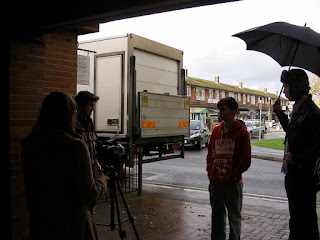
We arranged to meet up in Culcheth to film an interview with a takeaway worker and some shots of the takeaways around the area. We planned to film outside The Raj and the Village Pizza. A lot of the filming we did was done in the afternoon. This was because we hoped for the natural lighting onto the outside of the takeaways would be much better in the daytime than it is in the afternoon. This also meant that we wouldn't have to wait long before we could order a takeaway delievery in the evening. However, the weather on this day was not brilliant. It rained for some of the time. This limited the amount of filming we could do. Also, we did not have a cover for our camera when it rained, so whenever our filming was interupted by the weather, we were forced to quickly put our camera away again to avoid damage to our camera. We eventually brought an umbrella and held it above the camera so that there was some filming that we could do.
We interviewed Andy Harrison, a part time takeaway worker who also fitted into our mostly teenage target audience. This meant that he has an understanding of young people's attitudes towards takeaways. We filmed him at the side of the Village Pizza takeaway. There was a roof at the side which protected our camera from getting damaged. We focused our camera at a medium close up with the camera facing upwards to demonstrate power. However, this shot is something we will not use because we decided that the mise-en-scene was too irrelevent. We felt that the lighting was too dark and that because the background of the shot was a road with cars driving past, it had no relation to our exposition. Andy was also wearing a dark red hoody because he was off duty. This too, was not relevent to our exposition.

We filmed some panning shots of takeaway signs and still close ups of takeaway menus. The menus in particular were used as a bridge for the next part of our filming: Shots of people eating chinese takeaways at a house. We wanted a variety of close up shots on different types of chinese food. Often, we used a downward tilt on the camera with an extreme close up shot. The extreme close up demonstrates the importance of the food in relation to the exposition.

Wednesday 26th October 2011
We went back to Culcheth the following Wednesday to re-film some of our shots from more than one angle. This gives us a better choice during the editing process of the shots we could use for the finished piece. Although we already had an interview arranged with the owner of The Raj takeaway, we tried to ask some of the other nearby restaurant owners if they would like to be interviewed. We asked in Village Pizza, although they were forced to decline because the owner was not present at the time. We also asked at the Indian restaurant next door to Village pizza. In this case, the owner was present, although he declined after reading our question sheet
Sunday 30th October 2011

Wednesday 26th October 2011
We went back to Culcheth the following Wednesday to re-film some of our shots from more than one angle. This gives us a better choice during the editing process of the shots we could use for the finished piece. Although we already had an interview arranged with the owner of The Raj takeaway, we tried to ask some of the other nearby restaurant owners if they would like to be interviewed. We asked in Village Pizza, although they were forced to decline because the owner was not present at the time. We also asked at the Indian restaurant next door to Village pizza. In this case, the owner was present, although he declined after reading our question sheet
Sunday 30th October 2011
My group filmed an interview with a mother who we plan to use as a reprentative of home cooking. We asked her the following three questions:
- Do you think young people consider about their diet when they order a takeaway?
- Do you think young people order a takeaway when they're alone, with friends or in need of a quick meal?
- Why do you think teenagers choose takeaways over home cooking?

Tuesday 1st November 2011
On this night, we filmed an interview with the owner of The Raj indian takeaway restaurant, Anhar. We made sure that we followed the codes and conventions of documentries; more specifically documentary interviews. My group constantly thought about our mise-en-scene to try and establish that it was correct in this sense. The interview was filmed outside The Raj Takeaways's kitchen. It was clear to the audience that it was near a takeaway kitchen because of the glass windows on the doors in the background which looked inside. He answered all of the questions we asked him.
Tuesday 8th November 2011
We re-shot some of our cutaway shots from Chilli Grill, a restaurant near the centre of Warrington Town. These were mostly various types of close up shots of the food and beverage that we bought for filming.
Thursday 10th November 2011
We began editing our documentary despite not filming vox pops yet. We cut the questions being asked off from the interviews with the two parents and the owner of the Raj Indian restaurant. The aim of this was to simply create a rough cut of what we had got so far.
Monday 21st November 2011
We filmed five vox pops interviews. We did say that we would like to film three more vox pops interviews with females, as we interviewed four males and only one female. Unfortunately, we lost some of the footage during the capture process. The sound quality on these clips was also very quiet and if we tried to make it more audible then the amount of white noise would dramatically increase. Therefore, we thought it was best for these these vocks pops to be filmed once more.
Tuesday 22nd November 2011
We found five more people to interview as vox pops. This time, there was no problem with the capturing process or in the audio, so these were included in our documentary. Like yesterday, these interviews were filmed using a blue screen.
Friday, October 21, 2011
Inital Plan
After a thoughtful analysis as to what our documentary topic could be, we decided that our documentary would be on the topic of takeaways. We chose this topic becuase we felt it is something that every member of the audience can relate to. We felt that it would be easier to collect data related to this topic because of the large number of takeaway shops in the the local area. Therefore, it is easier to find people who are 'experts' on this topic.

We learnt about the scheduling in documentaries on many TV channels. This is so it gives us a good idea as to we when could schedule our documentary. The types of scheduling can be found below:
Inheritance - This is when the channel controllers air a documentary on after a popular show such as Coronation Street - in doing so, people may feel the need to leave their television on so that the documentary can 'inherit' the audience of the more popular show.
Pre Echo - Works in the opposite way to inheritance; a documentary could be put on before a popular show such as Coronation Street. The audience waiting to watch Coronation Street may turn the channel on early so to not miss the start of Coronation Street, and in doing so may end up watching part of or the entire documentary.
Hammocking - A sort of combination of inheritance and pre echo, where a documentary can be sandwiched in between two popular programmes on a channel and may gain extra viewers via both or either of inheritance and pre echo, and also viewers who leave the channel on after the first show as they wish to watch the second popular programme.
We also were familiarised with the types of documentary featured on different British television channels.
BBC 1 - These documentaries tend to be aimed at families.
BBC 2 - These are often the most educational documentaries out of the five main channels. However, these a sometimes more explicit and less suitable for children than the documentaries shown on BBC1.
ITV1 - The friendliest of the five channels. They are less serious documentaries than the ones aired on BBC1 and try to appeal to all audiences. ITV has shown serious documentaries in the past, including the controversial 2007 film 'Malcolm and Barbara Lover's Farewell' by Paul Watson. This documentary caused a scandal regarding the false death of Alzheimer's patient Malcolm Pointon, who actually died three days after his "death scene". Despite this, the film did raise awareness for Alzheimer's which some would argue was original goal of the documentary. This documentary was shown after 9pm to avoid upsetting any children.
Channel 4 - Many of Channel 4's documentaries are aimed at students and younger people. Often, they will have some comedy elements to them, such as in 'My Big Fat Gypsy Wedding'.
Channel 5 - These documentaries are aimed at families, although Channel 5 as a whole is thought to not differentiate it's programs enough from BBC1 and therefore does not gain as much of a large audience.
After some discussion, we came to the decision that our documentary would be called 'Tastes Like Teen Spirit' and that we wanted our target audience to be mostly students and drawing some attention from adults. The title of our documentary is a take on the world-famous Nirvana song 'Smells Like Teen Spirit'. We felt that this would be a good title as it will appeal to our target audience who will most likely be aware of the song and how the title is a play on words. We decided that it would be best for our documentary to be shown on Channel 4 on a Thursday at 8pm. This would Hammock our documentary in between the seven o'clock Channel 4 news (who are likely to have slightly more mature viewers) and Educating Essex, a documentary that is likely to be aired after ours. We decided that 8pm would be a good time to broadcast our documentary as this is a time when we believe that a large number of young people would be watching television. Many students are busy with education or work during the day time. We felt that Thursday would be a the best day because at the weekend, a lot of our target audience enjoy socialising in the evenings by visiting clubs or bars.
|
Subscribe to:
Posts (Atom)